
Amna Shabib: A Voice Written to Be Heard.
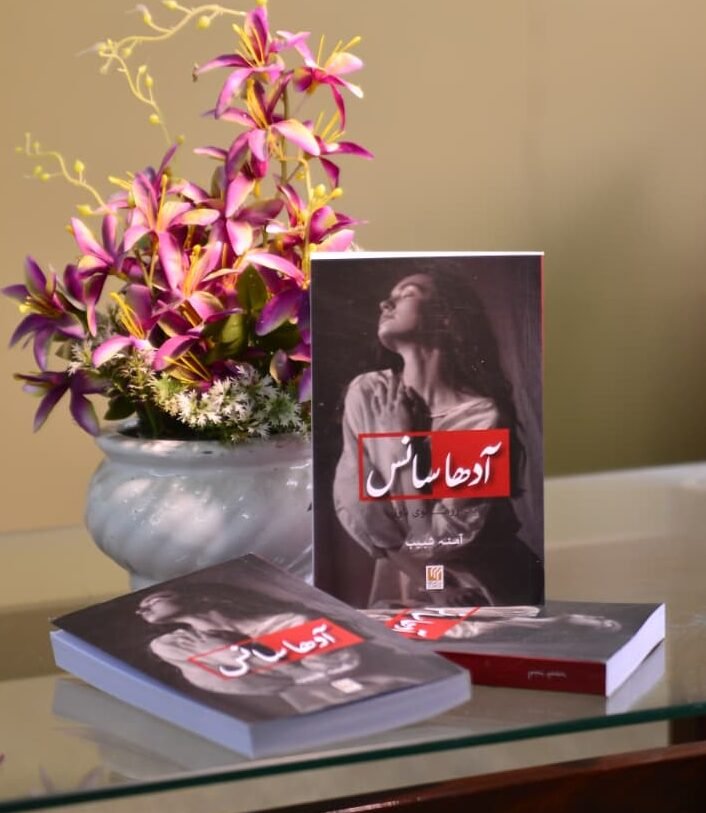
Amna Shabib is a novelist, poet, and screenwriter whose work moves between Urdu literary tradition and contemporary English prose. Her debut novel, Aadha Saans, is a story about distance, memory, and the words two people never quite manage to say — available now as a digital PDF or a printed edition.

Who is Amna Shabib? Amna Shabib is a Pakistani writer working across three forms — the novel, the poem, and the screenplay. She writes in both Urdu and English, drawing on classical Urdu literary sensibility while telling stories that feel immediate and personal. Her debut novel, Aadha Saans, was released as a digital PDF (PKR 500) and a printed edition (PKR 1,000 plus PKR 300 delivery).
The Story Behind Amna Shabib’s Writing
Every writer has a language they think in before they have a language they write in. For Amna Shabib, that first language was Urdu — its cadence, its restraint, its habit of saying the smallest thing in a sentence and leaving the largest thing unsaid. That instinct never left her. It shows up in her novels, in her poetry, and in the scripts she writes for the screen, even when the words on the page are in English.
Amna Shabib describes herself less as someone who chose to write and more as someone who noticed, early on, that writing was the only way certain feelings made sense to her. Grief made sense on a page. Longing made sense on a page. The strange, specific loneliness of loving someone from a distance made sense on a page, long before it made sense anywhere else. That is still the engine behind almost everything she writes: not plot for its own sake, but emotional truth first, story second.
Her work moves comfortably between Urdu and English because she sees them less as separate toolkits and more as two ends of the same instrument. Urdu gives her the weight — the ghazal-adjacent rhythm, the layered metaphor, the cultural memory embedded in certain words that simply do not translate. English gives her reach — a wider readership, including the Pakistani diaspora and international readers encountering South Asian literary fiction for the first time. Writing across both languages is not a stylistic gimmick for Amna Shabib; it is how she stays honest to a bilingual, bicultural inner life that most of her readers recognize in themselves.
Thematically, her fiction and poetry return again and again to a small cluster of ideas: distance (physical, emotional, generational), the things people almost say, memory as something unreliable but sacred, and the quiet interior lives of women who are rarely given the full page in traditional Urdu storytelling. Readers often describe her prose as “restrained” — and that restraint is deliberate. Amna Shabib writes toward the pause, not around it.
That philosophy is baked directly into the title of her debut novel. Aadha Saans translates loosely as “a half breath” — the incomplete inhale that happens in the space between what a person feels and what a person actually says out loud. It is, in many ways, the clearest possible summary of what her writing is trying to do: live in that unfinished breath, and give it a shape.
Alongside fiction, Amna Shabib writes poetry rooted in the same emotional register, and she works as a screenwriter, translating those same themes of distance and unspoken feeling into scenes, dialogue, and visual storytelling. Across all three forms — novel, poem, script — the throughline is consistent: a writer more interested in what a character cannot say than in what a character does.
Poetry & Prose: Amna Shabib’s Literary Work Beyond the Novel
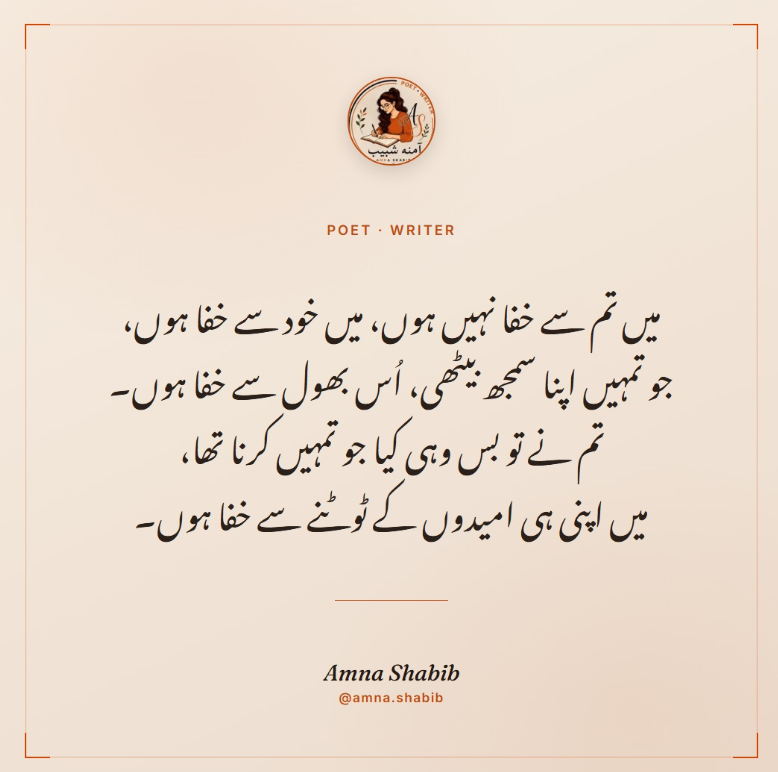
While Aadha Saans is her first published novel, Amna Shabib’s writing life extends well beyond fiction. She writes poetry that sits comfortably alongside her prose — shorter, more compressed, but built from the same emotional material: distance, memory, the ache of things unsaid. Where the novel has room to develop a relationship over chapters, her poems try to capture the same feeling in a handful of lines, which is its own kind of discipline.
She also works as a screenwriter, which pulls her writing in a different but related direction. Fiction and poetry live inside a character’s head; screenwriting forces those same internal feelings out into dialogue, gesture, and scene. Writing for the screen has sharpened her instinct for what a reader — or viewer — actually needs to be told versus what they can be trusted to feel on their own, a skill that shows up clearly in how sparingly Aadha Saans explains its characters’ emotions.
Themes in Amna Shabib’s Writing
- Distance — physical, emotional, and generational gaps between people who care about each other
- Unspoken words — the things characters almost say, and what that silence costs them
- Memory — treated as unreliable, selective, and emotionally sacred rather than factual
- Urdu literary influence — restraint, layered metaphor, and rhythm carried into English-language prose
- Interior lives of women — inner monologue and emotional complexity given full narrative space
Readers who enjoy Aadha Saans and want more of this voice can explore her ongoing poetry and prose, published and updated on the work page, and can follow new pieces as they’re released via her Instagram.
Questions About Amna Shabib and Aadha Saans
Who is Amna Shabib?
Amna Shabib is a Pakistani novelist, poet, and screenwriter who writes in both Urdu and English. She is the author of the debut novel Aadha Saans and writes poetry and screenplays exploring themes of distance, memory, and unspoken emotion.
What is Aadha Saans about?
Aadha Saans is a novel about the distance between two people and the words it takes to close it. It explores memory, longing, and restraint, told in a voice shaped by Urdu literary tradition and contemporary storytelling.
How much does Aadha Saans cost?
The digital PDF of Aadha Saans costs PKR 500. The printed copy costs PKR 1,000 plus PKR 300 for delivery, for a total delivered price of PKR 1,300.
How do I buy Aadha Saans?
Aadha Saans is ordered directly through Amna Shabib’s contact page. Visit /contact/, choose the digital PDF or printed copy, and send your order details to receive payment and delivery instructions.
What does the title Aadha Saans mean?
Aadha Saans translates loosely from Urdu as “a half breath.” It refers to the incomplete space between what a person feels and what they actually say out loud — the emotional territory the novel is built around.
Does Amna Shabib write in English or Urdu?
Amna Shabib writes in both languages. Her work carries the rhythm and restraint of Urdu literary tradition even when it’s written in English, reflecting a bilingual, bicultural creative voice.
Where can I read more of Amna Shabib’s poetry and prose?
Her ongoing poetry and prose are published on the work page at /work/, with new pieces shared regularly through her Instagram, @amna.shabib.
Is Aadha Saans suitable for book clubs?
Yes. Its shorter length, emotional depth, and themes of distance, memory, and unspoken feeling make it well suited to book club discussion and reading circles interested in literary fiction.
Choose digital or printed.
The digital PDF is PKR 500. The printed copy is PKR 1,000 plus PKR 300 delivery. Use the contact page to place your order and send your details.
